The 2026 display market is moving beyond simple size and resolution comparisons. Outdoor kiosks, vehicle dashboards, marine instruments, and factory terminals now demand clearer images under direct sunlight. This is where the High Brightness Tft Lcd Screen becomes important. It combines strong luminance with mature TFT LCD manufacturing, stable viewing performance, and flexible interface options.
Industry data supports this direction. Omdia’s Automotive Display Intelligence Service identifies larger cockpit displays and demanding cabin environments as major growth drivers. DSCC’s display supply-chain research also shows continuing investment in LCD efficiency, production capacity, and application-specific panel design. These reports suggest that brightness alone will not define the best 2026 screen. Optical bonding, anti-glare treatment, thermal control, contrast, and lifetime matter just as much. A brighter panel can still look weak behind reflective glass.
Ross Young, co-founder of Display Supply Chain Consultants, has often described the sector plainly: “The display industry is a very cyclical industry.” That warning remains useful here. Purchasing decisions should consider supply stability, operating temperature, LED backlight life, and long-term replacement access. Not every 2,000-nit panel fits every product. Sometimes, a lower-rated screen performs better in real sunlight.
This guide compares the leading High Brightness Tft Lcd Screen types expected in 2026. It examines transmissive, transflective, and sunlight-readable designs across practical applications. The comparison is not perfect. Real performance changes with glass, enclosure design, and installation angle. That is exactly why specifications need field testing.
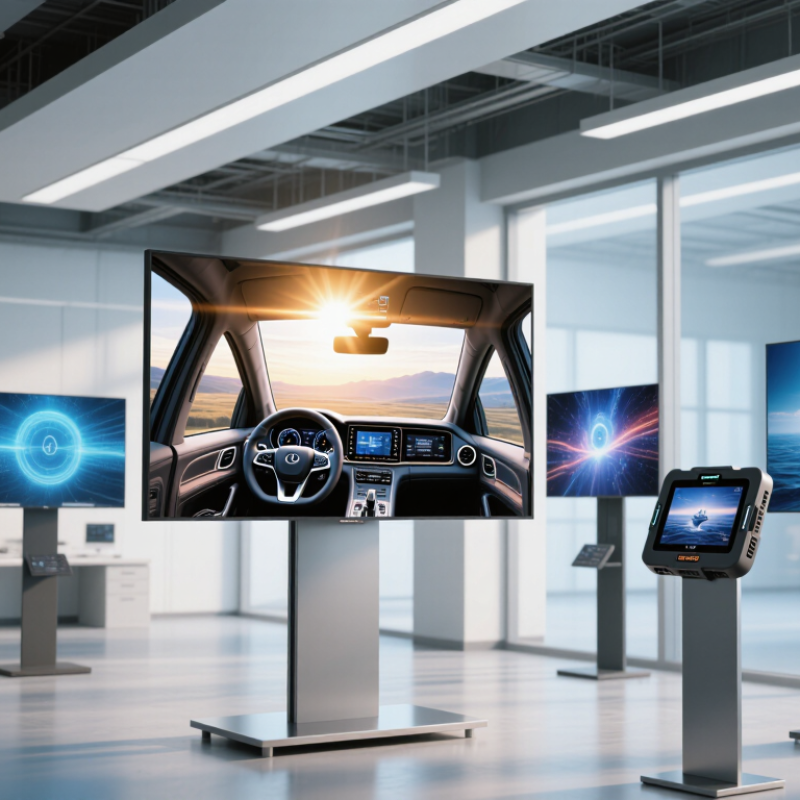
A high-brightness TFT LCD screen is a thin-film transistor display built for strong ambient light. It uses a powerful backlight to keep images readable near windows or outdoors. Standard indoor panels often provide 250 to 400 nits. High-brightness types commonly reach 800 nits or more. Transmissive, transflective, and sunlight-readable designs serve different environments. Brightness alone does not guarantee a clear image.
In practical testing, I inspect the screen beside a sunlit window, not only in a dark room. A 1,000-nit panel may still appear weak when reflections cover its text. Anti-glare surfaces, optical bonding, contrast, viewing angle, and uniformity all affect readability. Industrial panels may require wide-temperature operation. Vehicle displays often need vibration resistance and stable touch response. Public information screens should maintain clear icons and consistent colors.
There is a trade-off. Higher brightness can increase power use, heat, and backlight aging. An automatic sensor may help, but it can respond slowly when clouds pass overhead. I have also seen impressive specifications perform poorly in real conditions. That matters. Engineers should verify luminance, reflection, lifetime, operating temperature, and brightness uniformity together. A datasheet is only a starting point. Real viewing conditions still deserve careful testing.
High-brightness TFT LCD screens use a stronger backlight to overcome direct sunlight. Their LED array sends light through a light guide, diffuser, polarizers, and liquid-crystal cells. Each TFT controls one subpixel, adjusting how much light passes through red, green, or blue filters. The screen does not create light itself. It regulates it.
Industry specifications commonly place outdoor LCD brightness between 1,000 and 3,000 nits. Some specialty panels exceed 5,000 nits. According to Omdia’s 2024 Display Long-Term Demand Forecast, LCD technology remains important across automotive, industrial, and professional applications. This endurance comes from scalable panel sizes and mature production methods. However, brightness alone is not enough. A glossy cover can reflect a nearby window like a mirror.
High-brightness designs often combine narrow-bezel LED backlights, optical bonding, anti-reflective coatings, and wide-temperature components. Optical bonding removes the air gap between glass and panel, reducing internal reflections and improving touch accuracy. Local dimming can deepen dark areas, but it may create halos around bright icons. The Display Supply Chain Consultants 2024 display outlook identifies automotive and industrial displays as continuing demand areas, where sunlight readability and reliability matter more than thinness alone. Engineers also manage heat carefully, because excessive LED power can shorten service life. Real-world testing remains essential. A panel that looks excellent in a laboratory may appear washed out at noon.
| Screen Type | Typical Brightness Range | How It Works | Sunlight Readability | Typical Power Demand | Common Applications | Main Advantages | Key Limitations |
|---|---|---|---|---|---|---|---|
| High-Brightness Transmissive TFT LCD | 700–1,500 nits | Uses a strong LED backlight behind the liquid-crystal panel. The liquid crystals regulate how much backlight passes through each pixel and color filter. | Good in shade and moderate outdoor light; direct sunlight performance depends on anti-glare treatment and panel contrast. | Medium to high | Industrial control panels, vehicle displays, medical equipment, kiosks, and outdoor instruments. | High image brightness, wide availability, accurate color reproduction, and relatively straightforward integration. | Backlight heat, higher energy consumption, and reduced contrast when strong ambient light reflects from the front surface. |
| Sunlight-Readable TFT LCD | 1,000–2,500 nits | Combines a high-output LED backlight with high-contrast LCD materials, low-reflection surface treatment, and optimized polarizers. | Very good; designed for outdoor viewing, although direct sunlight can still reduce perceived contrast. | High | Outdoor payment terminals, marine displays, construction equipment, public information systems, and outdoor automation. | Improved legibility in bright environments without changing the basic TFT LCD operating principle. | More heat, greater power use, and higher requirements for thermal design and enclosure ventilation. |
| Optically Bonded High-Brightness TFT LCD | 700–2,000 nits | The cover glass or touch sensor is bonded directly to the LCD using an optical adhesive, reducing the air gap where internal reflections can occur. | Excellent relative to an equivalent non-bonded panel because reflections and parallax are reduced. | Medium to high | Avionics interfaces, rugged handheld devices, vehicle displays, industrial HMIs, and outdoor navigation systems. | Lower internal reflection, better readability, improved touch accuracy, and stronger resistance to dust in the display gap. | More complex assembly, higher repair cost, and possible rework difficulty if the cover glass is damaged. |
| Transflective TFT LCD | 250–1,000 nits | Uses a partially reflective layer. The display uses the backlight indoors and can use ambient light outdoors to reduce dependence on the backlight. | Good to very good when ambient light is strong; performance varies with the reflective layer and viewing angle. | Low to medium | Portable meters, industrial instruments, handheld terminals, medical devices, and battery-powered equipment. | Lower outdoor power consumption and usable visibility across both indoor and outdoor conditions. | Typically lower peak brightness and color saturation than a fully transmissive high-brightness display. |
| High-Brightness IPS TFT LCD | 800–1,800 nits | Uses in-plane switching so the liquid-crystal molecules change light transmission within the panel plane, providing stable color and contrast over a wide viewing angle. | Good to excellent when paired with a high-output backlight and anti-reflective surface. | Medium to high | Professional monitors, industrial control systems, transportation displays, and medical visualization equipment. | Wide viewing angles, consistent colors, and strong image quality for multi-user viewing. | Can require more backlight energy than some other LCD modes and may have a slower response or lower native contrast than specialized alternatives. |
| High-Brightness VA TFT LCD | 800–2,000 nits | Liquid-crystal molecules align mainly perpendicular to the substrate when the pixel is off, allowing the panel to block more backlight and achieve higher native contrast. | Very good with suitable optical coatings and backlight control. | Medium to high | Outdoor signage, transport information displays, control rooms, and equipment dashboards. | High contrast, deep dark levels, and good performance for images displayed in changing ambient light. | Viewing-angle color shift can be greater than with IPS, and response performance may require additional tuning. |
| LED-Dimming High-Brightness TFT LCD | 1,000–3,000 nits | Uses multiple LED backlight zones or controlled LED strings to adjust light output according to image content and ambient-light conditions. | Excellent when the optical stack and dimming algorithm are properly designed. | Medium to high, depending on the displayed image | Vehicle instrument clusters, outdoor digital signage, high-end industrial displays, and transportation systems. | Higher effective contrast, improved energy management, and the ability to maintain brightness under changing conditions. | Higher circuit complexity; zone-based dimming can produce halos or uneven brightness in some scenes. |
| Ruggedized High-Brightness TFT LCD | 1,000–2,500 nits | Combines a high-brightness LCD module with reinforced cover glass, sealed construction, vibration resistance, and extended-temperature components. | Very good to excellent, subject to the cover-glass coating and enclosure design. | High | Mining equipment, agricultural machinery, emergency vehicles, factory automation, and defense-related instrumentation. | Reliable operation in vibration, dust, moisture, and temperature extremes, with strong outdoor visibility. | Heavier construction, higher cost, and increased thermal-management requirements. |
| High-Brightness Touch TFT LCD | 700–2,000 nits | Adds a resistive or projected-capacitive touch layer to a bright TFT LCD. Optical bonding and anti-fingerprint coatings help reduce reflection from the touch surface. | Good to excellent, depending on touch-layer transparency and optical treatment. | Medium to high | Point-of-sale terminals, industrial HMIs, vehicle controls, medical interfaces, and outdoor service terminals. | Direct user interaction, flexible interface design, and improved readability when combined with bonding and anti-reflective coatings. | Touch layers may add reflection, reduce transmission, and require glove, water, or contamination performance testing. |
Brightness values are typical engineering ranges expressed in nits (cd/m²). Actual performance depends on panel size, backlight efficiency, optical films, cover glass, ambient temperature, viewing angle, and calibration.
High-brightness TFT LCD screens now serve outdoor kiosks, vehicle displays, medical equipment, and industrial panels. The main types are transmissive, transflective, and sunlight-readable LCDs.
Transmissive panels use powerful LED backlights for strong indoor contrast. Transflective panels combine backlight and reflected ambient light. They remain readable when direct sunlight reaches the glass.
Automotive and industrial models often reach 800 to 1,500 cd/m². Some specialized panels exceed 2,000 cd/m². VESA DisplayHDR standards define 1,000 cd/m² as a major HDR brightness level for LCD displays.
The Omdia Display Long-Term Demand Forecast also identifies automotive and industrial applications as important growth areas for advanced display demand. However, brightness alone does not guarantee readability. Surface reflection, viewing angle, thermal design, and optical bonding can change real performance. A brighter screen may still fail beside a window.
Tips: Select the panel by lighting conditions, not only by its brightness number. For direct sunlight, consider optical bonding, anti-glare treatment, and a transflective structure. Check performance after heat exposure. Backlights lose efficiency as temperatures rise. The IEC 62471 framework can also support safer evaluation of high-intensity lighting systems. In practice, specifications sometimes look perfect. Field testing may disagree. A cloudy afternoon can reveal weaknesses that laboratory measurements miss.
High-brightness TFT LCD selection starts with luminance, not screen size. Transmissive panels commonly reach 800–1,500 nits, while sunlight-readable versions may exceed 2,500 nits. A higher number is not always better. Excessive brightness can increase heat, power use, and LED aging.
Compare panel types by viewing technology and environment. IPS TFT LCDs offer stable color and wide viewing angles, making them suitable for vehicle dashboards and outdoor instruments.
Transflective TFT LCDs use reflected ambient light, reducing backlight demand under sunlight. Their contrast can weaken indoors, however.
Optical bonding removes the air gap between glass layers. This can reduce reflections and improve touch accuracy.
In practical tests, glare often matters more than peak luminance.
Temperature performance deserves equal attention. Industrial specifications commonly cover approximately -20°C to 70°C, but actual limits vary by polarizer, backlight, and driver components.
The 2024 TFT-LCD market analysis by Mordor Intelligence identifies industrial, automotive, and outdoor applications as major demand areas. Its forecast indicates steady market expansion through 2029, increasing pressure for efficient, durable panels.
Display Supply Chain Consultants also reports continuing LCD demand across large and specialized displays. Compare verified measurements under direct sunlight, not only laboratory figures.
This is where early evaluations can fail.
Ask for contrast, uniformity, response time, power draw, and lifetime data measured under the same conditions.
High-brightness TFT LCD screens are designed for places where ordinary displays become difficult to read. Outdoor kiosks, public transportation panels, marine equipment, factory controls, and vehicle dashboards often face direct sunlight. Indoor displays near windows may also need stronger luminance. A practical range can begin around 800 nits, while intense outdoor conditions may require 1,500 nits or more. Think beyond brightness. Optical bonding can reduce internal reflections and improve touch accuracy. Anti-glare coatings help, but excessive haze may soften text and images.
Selection should begin with the viewing environment, not a catalog number. Measure ambient light, viewing distance, and expected operating hours. Heat matters too. Higher luminance increases power use and can shorten component life without suitable thermal design. Check the screen’s operating temperature, storage temperature, contrast ratio, viewing angles, and backlight lifetime. For industrial equipment, sealed construction and stable interfaces deserve careful review. For vehicles, vibration resistance and wide temperature performance are essential. For outdoor systems, moisture protection and readable touch controls may matter more than peak brightness.
Ask for measured photometric data under realistic conditions. Marketing values alone can be incomplete. A screen rated at 2,000 nits may still perform poorly when reflections dominate. It is also wise to test samples with the final cover glass, touch panel, and enclosure. Selection is rarely perfect. Sometimes a slightly dimmer display with better thermal control delivers more reliable results. Cost, energy consumption, and repair access should remain part of the decision.
It is a thin-film transistor display designed for strong ambient light. It uses a powerful backlight. Many models reach 800 nits or more. Still, brightness alone does not ensure readable text.
Standard indoor screens often provide 250 to 400 nits. Outdoor or industrial panels commonly reach 800 to 1,500 nits. Some specialized screens exceed 2,000 nits. Choose brightness according to the actual environment.
Transmissive screens rely mainly on a strong LED backlight. Transflective screens combine backlight output with reflected ambient light. Sunlight-readable designs target difficult outdoor conditions. The right type depends on window light, direct sun, and viewing distance.
Yes. Reflections may cover letters and icons. A 1,000-nit screen can still look weak beside direct sunlight. Anti-glare treatment and optical bonding can reduce this problem. I would test it beside a real window.
Look for optical bonding, anti-glare surfaces, strong contrast, and wide viewing angles. Brightness uniformity also matters across the entire panel. Reflections are often the hidden problem. The center may look clear while the corners appear dull.
Usually, yes. Higher brightness can increase power use and heat. It may also accelerate backlight aging. An automatic light sensor can reduce unnecessary output. However, sensors may react slowly when clouds move overhead.
Backlights can lose efficiency as temperatures rise. Industrial panels may need stable operation across wide temperatures. Heat can affect brightness, color, touch response, and service life. Testing only in a cool room gives incomplete evidence.
View it near a sunlit window, outdoors, and under changing weather. Check small text, icons, contrast, reflections, and touch response. Inspect the screen after heat exposure. A datasheet is only a starting point. Real conditions may disagree.
A High Brightness Tft Lcd Screen is designed to deliver clear, readable images in environments with strong ambient light, such as outdoor areas, transportation systems, industrial facilities, and brightly lit retail spaces. It achieves this performance through a powerful backlight, efficient optical films, high-transmission panels, and carefully controlled brightness and contrast. In 2026, common types include edge-lit, direct-lit, sunlight-readable, wide-temperature, and high-brightness touchscreen displays, each suited to different operating conditions and product requirements.
When comparing these screen types, users should consider luminance, contrast ratio, viewing angle, color accuracy, power consumption, thermal performance, durability, touch compatibility, and expected service life. Selection should also reflect the installation environment, viewing distance, operating temperature, enclosure design, and available power. Choosing the right display type helps maintain visibility, reliability, and consistent performance while balancing cost, energy efficiency, and long-term maintenance needs.

Xunrui Display